The story
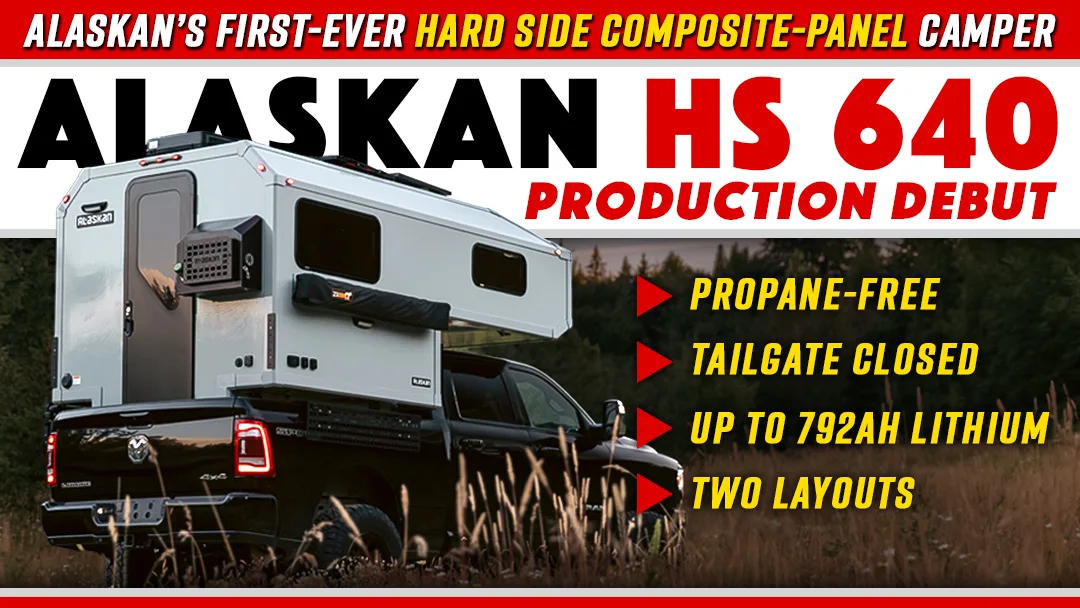
Alaskan Campers has introduced the production version of the HS 640, a hard-side, non-slide truck camper for short-bed pickups. The model expands the company’s product range beyond its traditional wood-framed hard-side pop-up campers.
The HS 640 uses 1.5-inch composite panels with PIR foam insulation and fiberglass skins. Alaskan lists an R11 insulation rating and says the panels are rot-proof. A patent-pending aluminum and PVC frame is intended to reduce thermal bridging, while dual-pane acrylic windows provide lower weight and additional insulation compared with glass.
The camper has an interior floor length of 5 feet 8 inches and interior height of 6 feet 5 inches. It is designed to remain within the truck’s footprint with the tailgate closed. Buyers can select between two layouts: one emphasizing seating and another adding a full-height storage cabinet.
Alaskan reports a loaded weight of 1,976 pounds for the illustrated Layout 2 camper and estimates a dry base weight of approximately 1,500 pounds. MSRP starts at $47,950 for Layout 1 and $48,995 for Layout 2.
The HS 640 is propane-free. Its systems include a diesel heater, electric tankless water heater, optional induction cooktop, 12-volt air conditioner, 90-liter refrigerator and a Victron electrical system. Standard electrical equipment includes two 162-amp-hour lithium batteries, a 3,000-watt inverter, a 200-watt roof-mounted solar panel, a 50-amp DC-to-DC charger and a GX Touch monitoring display. Optional expansion raises the battery capacity to 792 amp-hours and solar capacity to as much as 1,000 watts.
Alaskan is building the HS 640 in a new 15,000-square-foot facility across from its original plant. The new building is dedicated to composite-panel production, while the original facility continues building the company’s traditional pop-up campers. First customer deliveries were scheduled for September 2026.
Why it matters
The HS 640 brings composite construction, propane-free systems and a dedicated production facility into a brand historically associated with pop-up campers. It also targets buyers seeking a more weather-sealed alternative without moving to a large hard-side camper.