The story
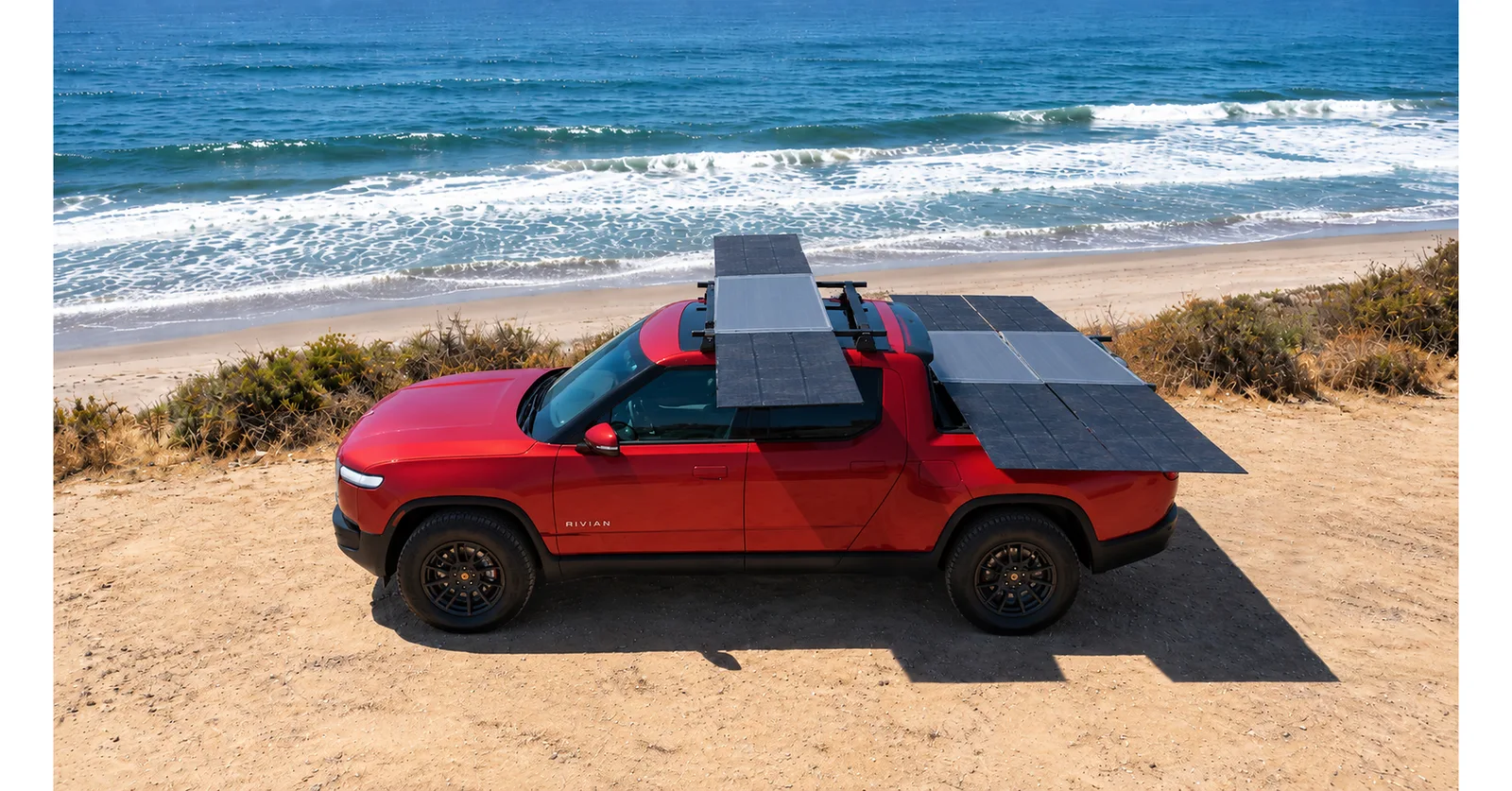
Los Angeles-based DartSolar announced October 27 that deliveries of its expandable vehicle-mounted solar array are scheduled to begin in December 2026 for pre-order customers. The system is designed to mount to standard roof racks or truck beds without drilling, creating a deployable solar surface that can be carried compactly during travel and extended when parked.
According to the company’s announcement, each module measures approximately 23 inches wide by six feet long when contracted and can extend to roughly 15 feet when deployed. Two modules are intended to provide up to 1,000 watts on a sedan roof rack, while three or four modules can be combined on a light truck for approximately 1,500 to 2,000 watts. Larger configurations are intended for vans, trailers, and campers.
That output range is materially larger than the rooftop solar systems commonly installed on slide-in campers. A conventional camper roof may accommodate 200 to 600 watts depending on vents, air conditioners, antennas, and available mounting area. DartSolar’s approach moves some or all of the array onto a rack or bed-mounted structure, potentially allowing a camper to carry a much larger charging system without permanently filling its roof.
The trade-off is deployment. The modules are designed to expand only when stationary, so they add setup time and require a clear area around the vehicle. A truck camper owner would need to consider whether the array can be deployed beside the vehicle, above the bed, or from a rack without interfering with doors, awnings, jacks, or neighboring campsite traffic. The system is therefore more suitable for stationary basecamp use than for continuously charging while driving.
DartSolar says each module is protected by a 4-millimeter polycarbonate shell and uses a quick-release locking system. The company also states that the array underwent high-speed testing to 100 mph, while recommending travel speeds below 70 mph. Those figures are manufacturer claims rather than independent certification. The array should not be operated while deployed in motion, and the shell, hinges, wiring, and attachment points will face the same dust, vibration, and weather exposure encountered by other exterior overland equipment.
The company says the system is intended to power portable power stations, jobsite tools, and auxiliary battery systems rather than serve as a primary electric-vehicle charging system. DartSolar has also released 3D CAD files for some structural plastic replacement parts under a share-alike license, which could make field repair more practical than with proprietary components.
For truck-camper users, the most important question is system integration. The array’s high potential output may exceed the input limits of many portable power stations and camper charge controllers. Owners would need suitable regulation, overcurrent protection, cable sizing, and a battery bank large enough to absorb the available energy. Used appropriately, the system could support high-demand basecamp loads; used without matching controls, its headline wattage would have limited value.
Why it matters
DartSolar offers a way to separate large solar capacity from a camper’s crowded roof, but its size, stationary deployment, and electrical-integration requirements make it a specialized basecamp solution.