The story
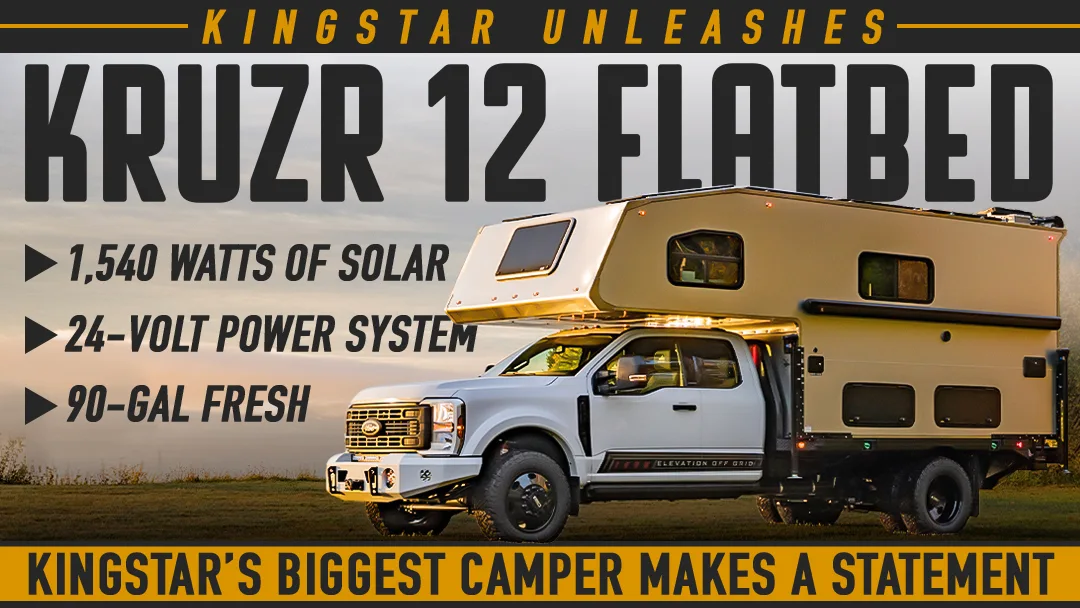
Kingstar has introduced the 2027 KRUZR 12, the largest camper in its current lineup and a direct move toward higher-capacity flatbed habitats. Truck Camper Magazine describes the unit as a hard-side, non-slide camper designed for Class 5 flatbed trucks rather than conventional pickup beds. That chassis requirement places it above the typical one-ton truck-camper market, but also gives Kingstar substantially more room for tanks, batteries, appliances and storage.
The KRUZR 12’s most distinctive specification is its fresh-water capacity. Kingstar lists a 90-gallon tank, a figure intended to support longer periods away from campground hookups. Truck Camper Magazine characterizes that capacity as the largest currently listed in its buyer’s guide, although the comparison depends on the guide’s coverage and should not be treated as a complete survey of every global manufacturer.
Electrical capacity is another major part of the design. The camper can be equipped with up to 1,540 watts of rooftop solar, arranged across fourteen panels, together with a large battery system. The available information confirms the solar figure but does not establish a single standard battery capacity or quantify expected air-conditioning runtime. That distinction matters: solar wattage is a generation rating under favorable conditions, while sustained cooling depends on battery size, temperature, shading, appliance loads and charging losses.
Kingstar also specifies 24-volt air conditioning. A higher-voltage air-conditioning system can reduce current draw through portions of the electrical installation compared with an equivalent 12-volt system, but it does not eliminate the underlying energy demand. Buyers will still need to evaluate battery capacity, inverter or direct-current architecture, and the truck’s alternator and charging provisions before assuming that the camper can support continuous cooling away from shore power.
The KRUZR 12 uses a hybrid-bath arrangement rather than a full dry-bath layout. Truck Camper Magazine reports that the model adds the company’s largest bathroom, expanded storage and a separate shower area, while retaining a non-slide floor plan. Avoiding slide-outs can reduce mechanical complexity and preserve structural simplicity, but it also means interior space must come from the camper’s footprint and vertical volume.
The real-world implication is that the KRUZR 12 is less a conventional slide-in and more a compact expedition apartment mounted to a heavy-duty commercial-style platform. Its water, solar and cooling specifications address the three constraints that most often limit extended boondocking: potable water, energy generation and heat management. The tradeoff is equally clear. Class 5 truck compatibility, a large flatbed and a substantial loaded mass will narrow the buyer pool, increase operating costs and require careful attention to axle ratings, center of gravity and route access.
Kingstar has not publicly established, in the available announcement, a complete delivered weight, standard battery configuration, price or production schedule. Those omissions prevent a full value comparison with other large flatbed campers. For now, the KRUZR 12 is best understood as a high-capacity platform whose significance lies in how far truck campers are moving toward self-contained, four-season expedition use.
Why it matters
The KRUZR 12 shows how premium truck campers are competing on water, solar and climate capacity, while also making the payload and chassis requirements of those ambitions impossible to ignore.