The story
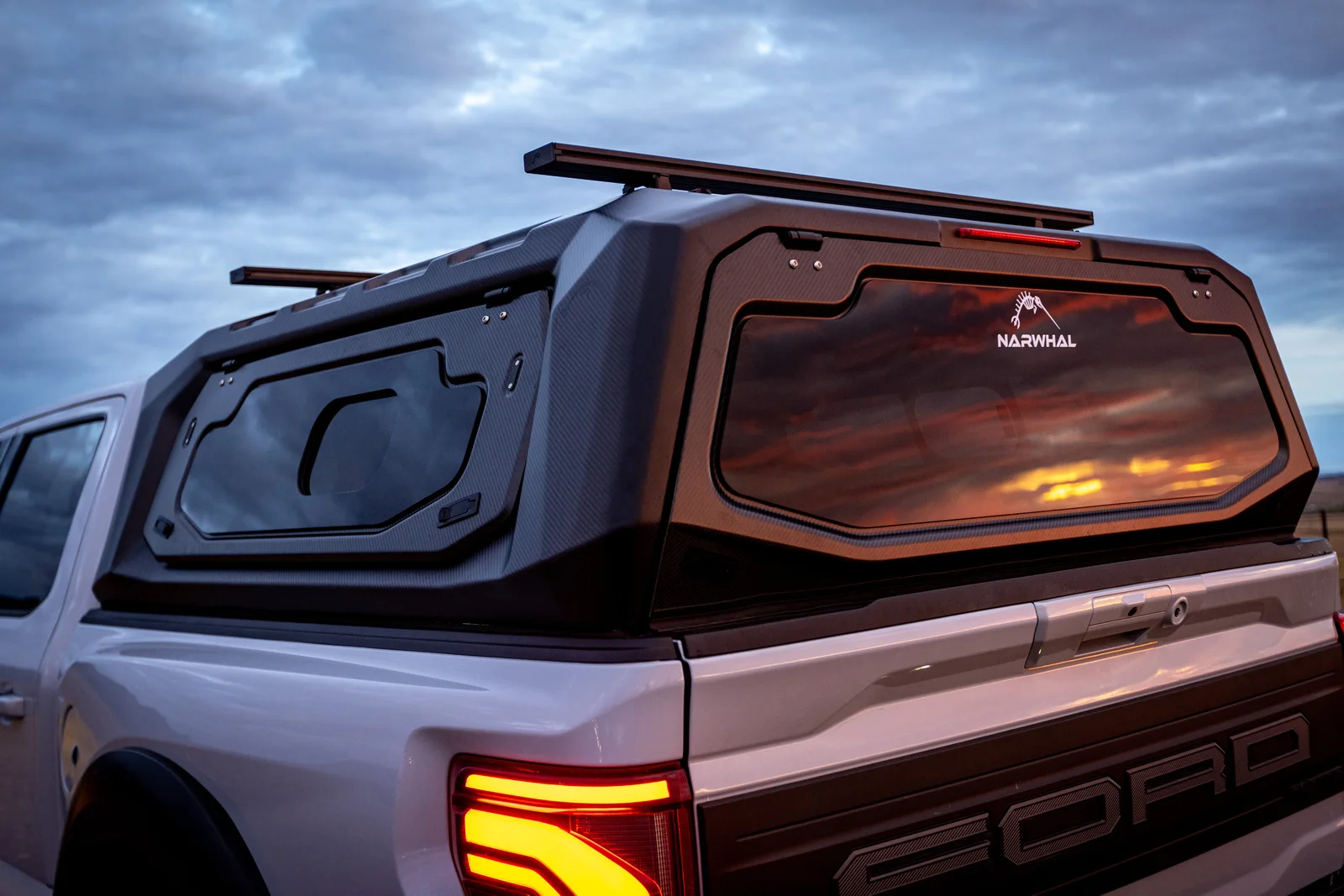
Narwhal Truck Toppers is advancing a lightweight carbon-fiber topper platform aimed at owners who want camper-like utility without the mass of a conventional fiberglass or aluminum shell. The company’s current product information lists a claimed installed weight range of approximately 100 to 160 pounds, depending on truck, bed length, rack system and options.
Narwhal describes the product as a structural carbon-fiber platform rather than a conventional cargo cap. Its stated objective is to add roof-load capacity and modular mounting capability while preserving pickup payload, suspension geometry and everyday driving characteristics. That positioning places the product between a traditional topper and an expedition-oriented camper shell.
The company lists dynamic and static roof-load figures of up to 600 and 1,100 pounds, respectively. Those figures are manufacturer claims and should not be treated as universal limits: actual allowable loads depend on the vehicle, mounting configuration, rack system, load distribution and whether the truck is moving or stationary. Buyers would also need to account for the weight of tents, awnings, batteries, water, recovery equipment and other accessories.
Narwhal’s published production status lists the Ford Ranger and Ford F-150 as in production, with next build slots identified for October 2026. Toyota Tacoma fitments are listed as being in tooling with a November 2026 launch target. The company also identifies planned or queued fitments for vehicles including the Toyota Tundra, Ram 1500, Chevrolet Silverado/GMC Sierra 1500, heavy-duty pickups and Jeep Gladiator.
The roadmap is explicitly presented as an engineering and production target rather than a guarantee. Narwhal says launch windows may change according to tooling and reservation demand. The company also states that actual specifications vary by truck model, bed length, rack system and installed options, limiting the usefulness of a single headline weight or load figure for cross-platform comparisons.
As a camping platform, the topper’s main advantage is flexibility. It can support rooftop tents, racks, awnings and other modular equipment while leaving much of the truck bed available for drawers, refrigerators, water systems or cargo. That may appeal to users who want a removable or adaptable setup rather than a self-contained slide-in camper.
Its limitations are equally clear. A topper alone does not provide the insulation, standing room, kitchen, plumbing or weather separation of a conventional camper. Converting it into a usable mobile habitat requires additional systems, and those additions can quickly reduce the payload advantage created by the carbon-fiber shell.
Narwhal’s approach reflects a broader trend toward low-mass truck-based habitats. Instead of placing all functions in one heavy module, manufacturers are separating the shell, sleeping platform, storage and power systems so owners can configure capability incrementally. The model will be most relevant to buyers who value everyday truck usability and modularity over a built-in RV interior.
Why it matters
A 100–160-pound structural topper could preserve payload for camping equipment, but the advertised load ratings and weight advantage must be evaluated with the complete rack, tent, battery and cargo system installed.