The story
OVRLND Campers is maintaining a deliberately small manufacturing model as it continues producing lightweight aluminum pop-up truck campers in Flagstaff, Arizona. In an interview published by Truck Camper Adventure, owner Jay Wellman said the company is focused on sustaining its operation rather than pursuing rapid growth, nationwide dealership expansion, or substantially higher production volume.
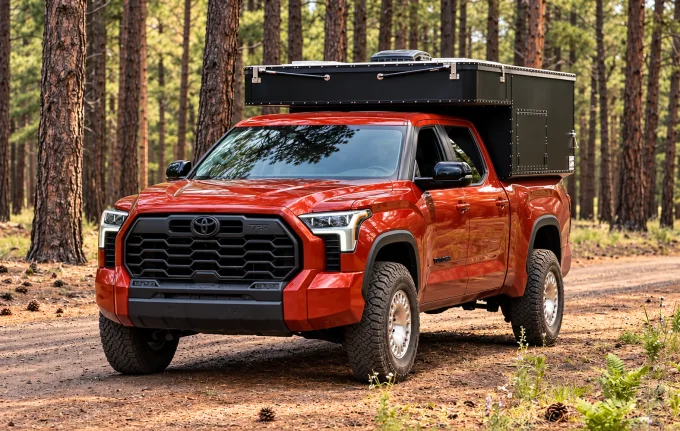
The company’s approach contrasts with a segment increasingly characterized by larger campers, higher electrical capacity, and more complex interiors. OVRLND’s core proposition remains a very light, simple pop-up structure intended to preserve pickup payload and off-road maneuverability. Truck Camper Adventure describes one OVRLND configuration as weighing approximately 220 pounds, although actual installed weight depends on the selected layout, windows, doors, interior components, and customer equipment.
The structural emphasis is aluminum construction. The company’s campers use an aluminum shell and pop-up roof rather than the heavier composite or fully equipped hard-side construction found in many newer models. That strategy allows OVRLND to serve owners who want a basic sleeping and shelter module without committing to the payload, center-of-gravity, and operating costs of a conventional slide-in camper.
The lightweight architecture also creates limitations. A low dry weight does not necessarily represent the operating weight after adding mattresses, batteries, water, cooking equipment, recovery gear, awnings, and personal cargo. Buyers still need to match the completed camper to the truck’s available payload and rear-axle rating. The pop-up format also generally provides less insulation, storage, and weather separation than a hard-side camper, although it offers a lower profile and reduced aerodynamic penalty while driving.
Wellman told Truck Camper Adventure that OVRLND approached approximately 30 employees during the pandemic-era demand spike but concluded that a smaller workforce—roughly 25 employees at the time of the interview—better fit the company’s quality and workplace objectives. The company’s current strategy is therefore not a capacity race. It is an effort to keep production manageable while maintaining the build methods that established the brand.
That decision has implications for availability. A controlled production rate can protect consistency, but it may also mean longer waits when demand rises. Unlike high-volume RV manufacturers, a small builder may have less ability to absorb supplier disruptions, sudden order increases, or model changes without affecting lead times.
OVRLND’s position is relevant as truck owners increasingly seek lighter campers for half-ton, midsize, and older pickups. The company demonstrates that there remains a market for a minimalist shelter-first product even as other manufacturers add large lithium banks, high-output solar arrays, wet baths, slide-outs, and residential-style interiors.
The available interview does not announce a new model, major price change, or formal capacity expansion. Its significance is operational: OVRLND is choosing to remain a specialized low-volume manufacturer, preserving a lightweight product philosophy rather than following the market toward larger and more heavily equipped campers.
Why it matters
OVRLND illustrates a countertrend to the industry’s move toward heavier, more complex campers: preserving payload and maneuverability through a minimalist aluminum pop-up design and controlled production.