The story
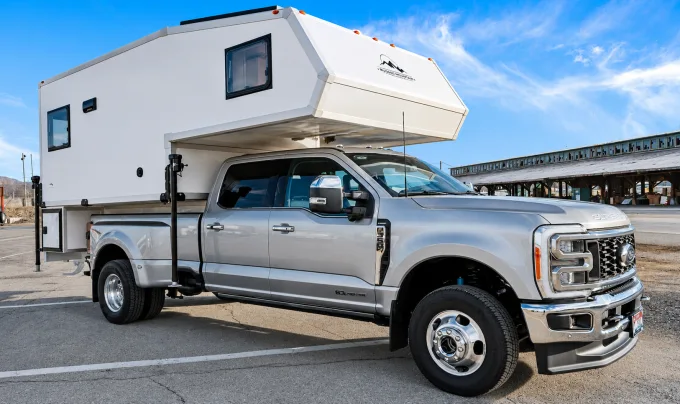
Rugged Mountain RV has introduced the Granite Platinum as a premium hard-side slide-in truck camper built around composite construction and an unusually large factory electrical system. Truck Camper Adventure reported the model on October 12, describing it as a full-composite camper with four-season capability, large holding tanks, and 1,200 watts of solar.
The Granite Platinum sits within the growing segment of truck campers that use composite panels and engineered structures to pursue a combination of durability, insulation, and weight control. Composite construction does not automatically make a camper light, however. The Granite Platinum is positioned as a substantial hard-side unit rather than a minimalist pop-up, so buyers will need to confirm the final wet weight, center of gravity, and required truck class for the selected floor plan and options.
The headline electrical specification is the 1,200-watt solar array. That figure places the camper above the solar capacity commonly found on conventional production slide-ins and is intended to support extended off-grid use. Solar capacity alone does not determine usable autonomy: battery storage, charge-controller limits, shading, seasonal sun angle, inverter loads, refrigeration, heating, and air-conditioning demand all influence how much energy the system can deliver in practice.
Rugged Mountain’s approach reflects a broader shift in truck-camper equipment. Buyers increasingly expect factory-installed lithium batteries, larger inverters, high-output solar, and electrical systems capable of supporting communications equipment and climate-control loads. Integrating those systems at the factory can improve wiring, protection, and packaging compared with piecemeal aftermarket installation, but it also raises purchase price and may add meaningful mass to the camper.
The Granite Platinum is also aimed at four-season use. That designation generally depends on insulation, thermal bridging, basement protection, heating distribution, window and door design, and water-system protection rather than on a single component. The available report identifies the camper as four-season capable but does not provide a complete thermal test protocol or quantified cold-weather performance. Buyers in severe climates should therefore ask for details on tank heating, furnace output, insulation values, condensation management, and winterization procedures.
Large holding tanks extend the time a crew can remain away from developed facilities, but they create a direct payload tradeoff. Fresh water weighs approximately 8.3 pounds per gallon before accounting for tank and plumbing hardware. The same principle applies to batteries, propane, food, clothing, recovery equipment, and personal gear. A high-capacity camper can deliver impressive autonomy while simultaneously requiring a higher-capacity truck.
The Granite Platinum’s most important market implication is that composite construction is now being paired with high-end electrical systems rather than used only to reduce weight. That combination appeals to owners who want a conventional hard-side interior and longer off-grid capability without moving to a full expedition vehicle.
The model should nevertheless be evaluated as a complete truck-and-camper system. Its value depends on whether the buyer’s pickup can carry the finished camper at travel weight while maintaining axle, tire, suspension, and center-of-gravity margins. The solar specification is significant, but it is only one part of the engineering and ownership equation.
Why it matters
Granite Platinum combines composite hard-side construction with a 1,200-watt solar system, illustrating how premium truck campers are becoming more self-sufficient while also increasing payload demands.