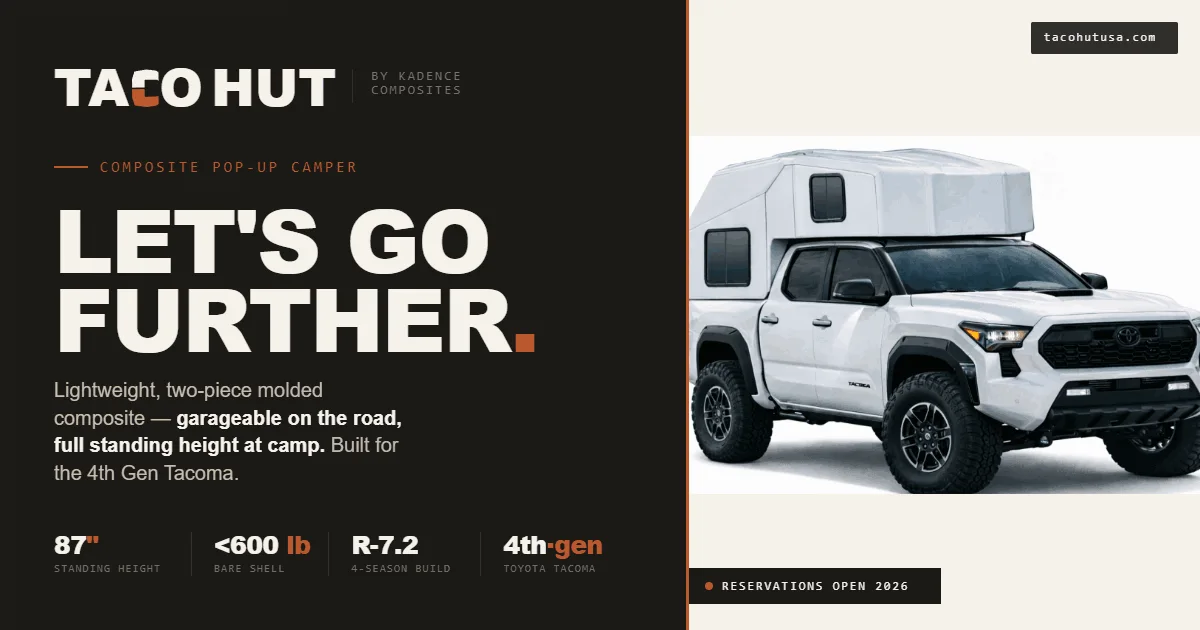
The story
TacoHut is positioning its forthcoming camper as a lightweight alternative for fourth-generation Toyota Tacoma owners who want standing room without the weight and height of a conventional hard-side slide-in. The company’s website identifies the product as a two-piece molded composite camper with a planned spring 2027 arrival and reservations beginning during 2026.
The published bare-shell weight is listed at 470–520 pounds, while the headline specification states that the shell weighs less than 600 pounds. Those figures appear to describe the uncompleted camper structure rather than a travel-ready unit. Buyers will need to add the weight of interior systems, mattresses, battery equipment, water, cooking gear, personal cargo, and any roof accessories before comparing the camper with Tacoma payload capacity.
TacoHut lists a 58-by-75-inch full-size bed and an interior height of 87 inches when deployed. The closed height is listed at 96.6 inches, although the site’s specifications should be interpreted in the context of the camper’s installation on a specific Tacoma configuration. Suspension, tires, bed hardware, and roof equipment can all change the final vehicle height and handling characteristics.
The company says the camper uses vacuum-infused composite construction and carries an R-7.2 four-season insulation rating. A molded composite shell can reduce the number of structural joints and eliminate some of the thermal bridges associated with conventional framed walls, but those advantages depend on the quality of the moldings, bonds, seals, and openings. The available product information does not establish a tested whole-camper thermal performance standard or document cold-weather plumbing protection.
The design’s main market proposition is payload preservation. Fourth-generation Tacoma buyers often face a narrower payload margin than owners of full-size or heavy-duty pickups, particularly after adding passengers, recovery equipment, suspension upgrades, and larger tires. A shell in the 500-pound range leaves more capacity for a basic interior, but a fully equipped camper can still approach the truck’s limits quickly.
The launch also reflects a continuing split in the pickup-camper market. Larger manufacturers are adding bathrooms, slide-outs, high-capacity batteries, and substantial solar arrays. TacoHut instead prioritizes a low mass, a compact footprint, and a pop-up roof that can provide standing room at camp while retaining a relatively narrow use case.
Further confirmation is needed on production pricing, final options, mounting hardware, ventilation, electrical provisions, water systems, and approval for different Tacoma bed lengths and trims. Until those details are published, the TacoHut is best viewed as a lightweight shell program with a defined target vehicle and a stated production timetable, rather than a fully specified turnkey RV.
Why it matters
The Tacoma is a major platform for lightweight truck campers, but payload limitations restrict conventional designs. TacoHut’s stated shell weight and composite construction could expand the usable design space if final equipped weight remains low.