The story
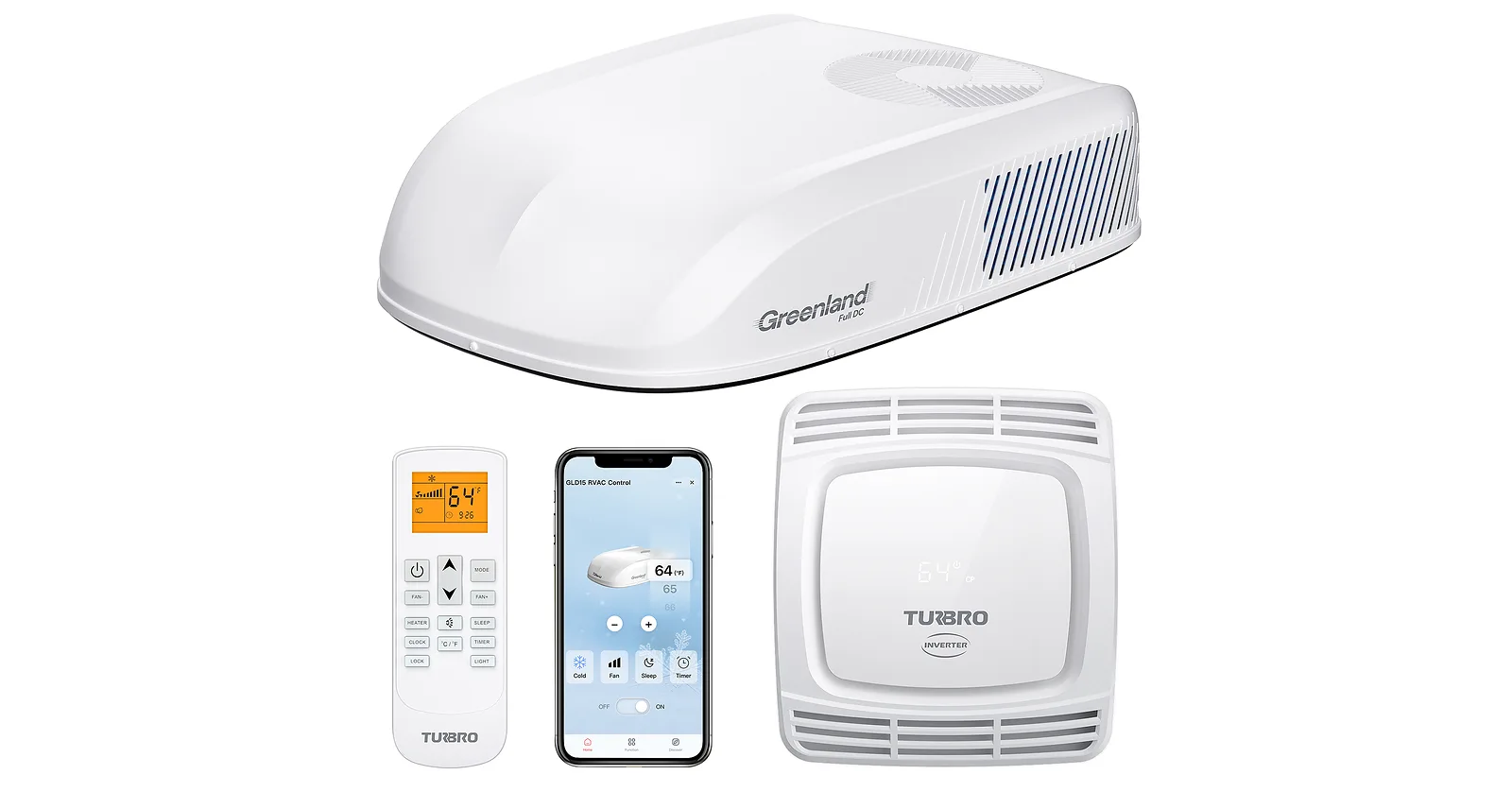
TURBRO has introduced the Greenland GLD15, a 15,000-BTU rooftop air conditioner designed for recreational vehicles and other mobile applications using 48-volt electrical systems. The unit was announced on October 26, 2026, and includes both cooling and heat-pump heating functions.
The central design choice is direct 48-volt operation. Conventional RV air conditioners commonly use shore power, generators, or battery systems connected through an inverter. A direct-current appliance can avoid one conversion stage when the vehicle already has a compatible 48-volt battery architecture. That does not eliminate energy consumption, but it can simplify the path between storage and the compressor.
TURBRO’s announcement uses a simplified comparison to explain the electrical implications. At a notional 1,200-watt load, a 12-volt system would require approximately 100 amps, while a 48-volt system would require approximately 25 amps before accounting for losses and real-world operating conditions. Lower current can reduce conductor size requirements and resistive losses, although the final benefit depends on cable length, battery voltage under load, inverter or converter efficiency, and the complete system design.
The GLD15 is rated at 15,000 BTUs, placing it within the output range of many full-size rooftop RV air conditioners. That capacity may be useful in hard-side truck campers, flatbed campers, and larger mobile habitats, but it may exceed the practical needs of small pop-up campers. Cooling demand also depends heavily on insulation, canvas exposure, window area, ambient temperature, humidity, and whether the camper is occupied in direct sun.
The unit’s 48-volt requirement is its principal limitation. Most pickup campers still use 12-volt electrical systems, and many compact models rely on modest lithium batteries, alternator charging, and portable solar rather than a dedicated 48-volt architecture. Retrofitting a 48-volt air conditioner into an existing camper could require a battery change, new protection equipment, revised charging hardware, and careful integration with 12-volt loads.
The announcement does not establish a measured runtime for a specific camper or battery pack. Actual endurance would vary substantially. A 15,000-BTU compressor may cycle differently depending on conditions, and heat-pump performance can change with outdoor temperature. Buyers should therefore treat the product’s electrical architecture as the main story rather than assume a universal 25% reduction in energy use.
For manufacturers, however, the product points toward a more deliberate split between low-voltage house loads and higher-voltage energy systems. As campers add larger lithium banks, induction cooking, electric heating, air conditioning, and solar charging, 48-volt equipment may become easier to package in premium off-grid builds. The practical question is whether enough manufacturers adopt compatible system standards to justify the added complexity for owners.
Why it matters
Air conditioning is one of the most difficult loads for battery-powered campers. A direct 48-volt rooftop unit could reduce current and conversion complexity in new high-capacity builds, but its value is limited for existing 12-volt truck campers unless the broader electrical system is redesigned.